

As organizations embrace AI agents alongside applications, services, and other machine identities, many are struggling to maintain visibility, control, and accountability across a rapidly expanding identity landscape. Unmanaged AI agents, non-human identity sprawl, and inconsistent access governance can increase security risk and make it difficult to determine who or what has access to critical systems and data. Vault 2.2 advances identity-centric security through the general availability of SCIM integration and new enhancements for non-human identities and agentic IAM. Together, these capabilities help organizations automate identity lifecycle management, govern AI agents and machine identities with the same rigor as human users, enforce least-privilege access, and improve auditability across their environments, all from a centralized identity foundation.
»Prevent identity sprawl and achieve trusted access with SCIM GA
Manual identity administration across identity providers and Vault can be difficult to scale, creating operational overhead and increasing the risk of access drift, misconfigurations, and outages. SCIM for Vault helps eliminate this challenge by automatically synchronizing human identities, ensuring access to Vault and protected resources remains aligned with authoritative identity data. As organizations move toward autonomous cloud operations, identity becomes the foundation of security and automation becomes essential for operating safely at scale. By automating human identity provisioning and lifecycle management, teams can reduce manual effort, strengthen governance, and focus on securing the growing number of machine and AI identities across their environment.
SCIM also strengthens delegated and agent-driven workflows by ensuring that human identities are consistently established and maintained before access is granted. This prevents identity drift between Vault and the identity provider, helping ensure that only authorized users, and the agents acting on their behalf, can access Vault-protected resources. The result is stronger governance, reduced operational risk, and greater confidence in identity-based security across both human and autonomous workflows.
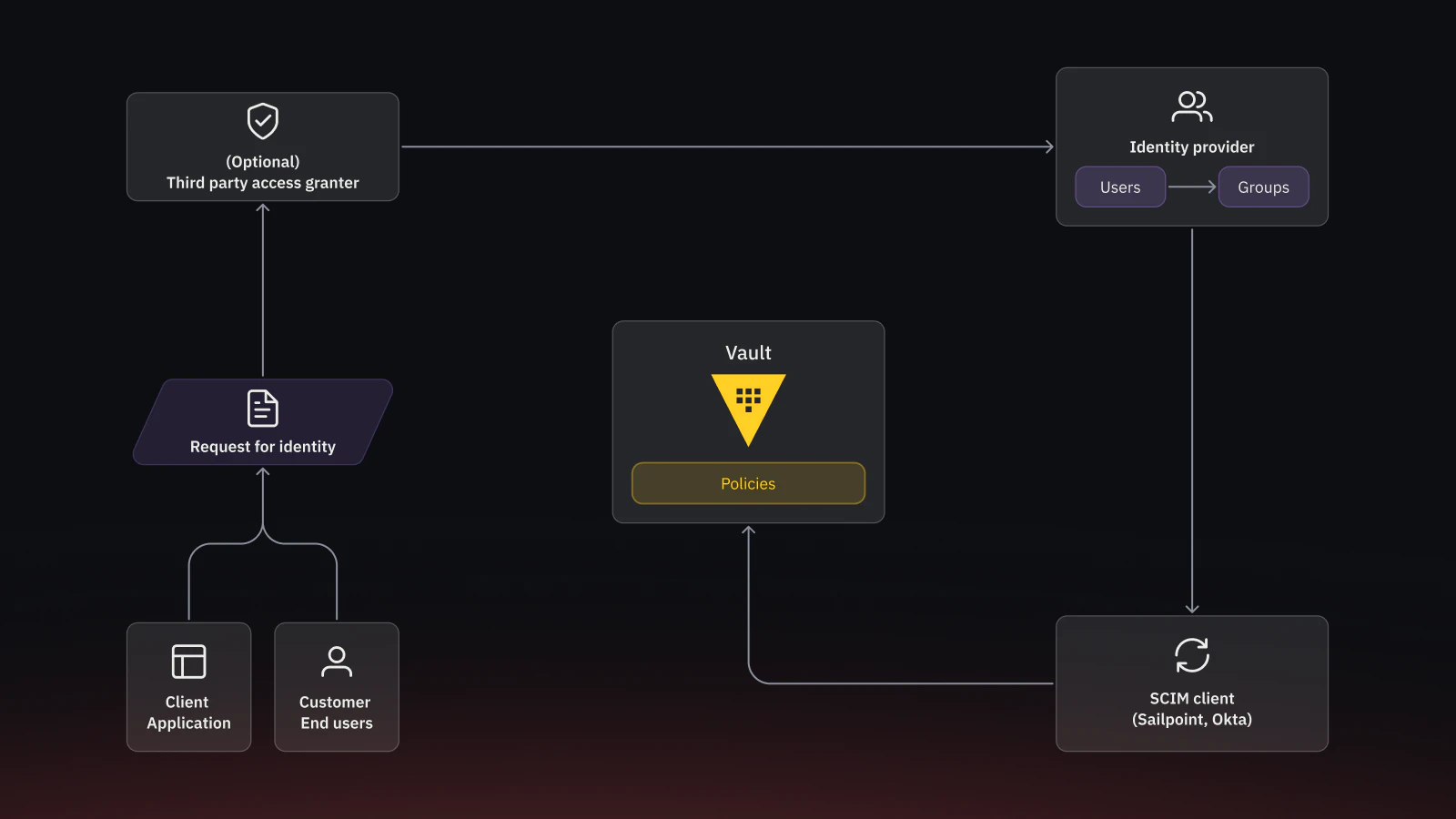
Figure 1: A high-level overview of the SCIM identity provisioning workflow into Vault.
»Streamline Vault entity and group adoption through precise updates
Previously, SCIM clients could only manage users and groups they had created themselves. With GA, SCIM clients can now adopt and manage pre-existing Vault entities and groups, not just the ones initially provisioned through SCIM. This closes a major gap for organizations with established Vault deployments who want to bring their existing identity footprint under SCIM-based lifecycle management without recreating entities from scratch. Teams migrating from manual provisioning to SCIM can now do so incrementally, without disruptive rip-and-replace migrations.
Teams can now also take advantage of more precise, less disruptive updates. SCIM now supports partial, targeted updates to identities in Vault rather than replacing the full record every time something changes, reducing the chance of accidental overwrites during routine updates.
»Validate integrations with leading identity providers
SCIM GA expands validated interoperability with Microsoft Entra ID alongside SailPoint and Okta, rounding out support for three of the most widely used enterprise identity providers. Each integration has been tested against Vault's SCIM implementation to confirm compatibility with real-world provisioning workflows, giving teams confidence to deploy SCIM with the IdP they already rely on and leverage their existing identity infrastructure.
»Expand Vault's identity governance and access controls for AI agents
Since our generally available release in September, we’ve continued enhancing HashiCorp Vault's capabilities for securing and governing AI agents.
As organizations adopt AI agents alongside applications and other machine identities, many are discovering that their existing identity and access management processes were designed primarily for human identities. Vault's agentic security enhancements help customers govern identities with confidence by combining verified agent registration, delegated authorization boundaries, and ephemeral per-request authorization.
Vault extends its core identity model to support the unique security requirements of AI agents. While human users and machine workloads are governed through established identity and access controls, AI agents require additional safeguards because they can interpret intent and execute dynamic, non-deterministic workflows. To address this, Vault introduces a purpose-built governance model that combines three layers of control:
Human baseline policy - the permissions of the human user on whose behalf an agent operates,
Agent ceiling policy - strict agent-specific permission boundaries that define the maximum privileges an agent can ever receive,
Rich Authorization Requests (RAR) - ephemeral authorization scoped to a specific task or request.
Every agent is tied to a trusted identity, governed by defined ceiling policies that establish maximum permissions, and authorized based on the specific task being requested rather than broad, long-lived access rights. By requiring rich authorization details for each request, Vault evaluates authorization in context, creates a clear and auditable record of every agent action, and enforces least-privilege access by default. This layered approach gives organizations the confidence to deploy and scale AI agents while maintaining strong governance, accountability, and control over autonomous actions.
Vault's agentic IAM is designed to work alongside the identity providers organizations already use, and it fits into the same infrastructure-as-code workflows teams use to manage the rest of their environment.
»Control every agent interaction with confidence
Vault gives organizations layered controls for governing how AI agents act and access resources. In delegated workflows, agents can act on behalf of users while remaining constrained by both the user’s permissions and the agent’s own authorization boundaries, helping keep every action within approved limits. When risk arises, security teams can revoke an agent’s active tokens and sessions on demand, removing access immediately rather than waiting for credentials to expire. At the same time, centralized visibility gives security and platform teams a single view of every registered agent, including its access, and activity, making oversight and audits simpler.
These controls fit into the identity ecosystem organizations already use. Vault’s agent identity workflows have been tested with Auth0, IBM Verify, Microsoft Entra ID, and Okta, helping teams extend governance to AI agents without introducing a separate identity system.
»Getting started
SCIM for Vault is now generally available for Vault Enterprise and Vault Dedicated customers. Teams that are already running SailPoint, Okta, or Microsoft Entra ID can connect existing provisioning workflows to Vault and start extending governance to both new and existing identities.
For detailed instructions on connecting an identity provider to Vault via SCIM, read the Vault developer documentation.
Agentic IAM is available now to Vault Enterprise customers. Teams should start by identifying their existing identity provider, whether that's Auth0, IBM Verify, Microsoft Entra, or Okta, and following Vault tutorials to begin governing agent access from day one. Visit the Vault documentation for detailed setup guides and deployment patterns.