AI agents are becoming active participants in infrastructure delivery and operations, fundamentally increasing the speed and scale at which infrastructure work can happen. This shift requires organizations to rethink how infrastructure is managed across its lifecycle and what it takes to operate safely in an agentic world.
As AI agents take on more infrastructure work, task-level automation is no longer enough. They need a trusted foundation and governed workflows that allow humans and agents to safely take action.
At HashiConf at TechXchange, we’re introducing Terraform capabilities to help organizations move toward governed, autonomous infrastructure operations:
· Terraform policy, generally available: Bring policy authoring and enforcement directly into Terraform with a declarative, HCL-based policy-as-code framework.
· Enhanced search with Terraform policy, public preview: Discover unmanaged infrastructure, evaluate compliance, and bring resources under Terraform management through an integrated workflow.
· Terraform Developer Portal, public preview: Extend HCP Terraform into governed self-service, allowing developers and AI agents to consume approved infrastructure patterns through the interfaces where they work.
· Remote Terraform MCP server, public preview: Connect AI agents to HCP Terraform without requiring developers to install or maintain the MCP server locally.
· Terraform intent-driven workflows for Z and LinuxONE, private preview: Bring discovery, rehearsal, and simulation to Terraform workflows for mission-critical infrastructure.
· HCP Terraform powered by Infragraph: Turn Terraform infrastructure data, relationships, and lifecycle context into near-real-time infrastructure intelligence for humans and AI agents.
These capabilities are designed to help organizations address the barriers to autonomous infrastructure and move toward operations where humans and AI agents can safely act at scale.
»Terraform provides the foundation for Agentic Infrastructure Lifecycle Management
Autonomous infrastructure requires humans and AI agents to operate from the same trusted foundation. They need shared context to understand infrastructure, governed workflows to safely take action, and connected intelligence to continuously operate as environments change.
Terraform brings these capabilities together across three connected stages:
Define: Codify approved infrastructure patterns, policies, operational practices, and organizational standards to establish trusted context.
Consume: Enable developers and AI agents to safely use approved patterns through governed self-service workflows.
Scale: Apply connected infrastructure intelligence to continuously govern, optimize, and operate with confidence at scale.
By connecting these stages across a common lifecycle, Terraform helps organizations move beyond automating individual tasks toward governed, autonomous infrastructure operations.
»Define: Establish trusted infrastructure context
Platform teams establish the foundation for autonomous infrastructure by codifying approved infrastructure, operational practices, and organizational standards as Infrastructure as Code.
»Bring policy directly into Terraform with Terraform Policy
Terraform is extending the ability to provide infrastructure guardrails with the Terraform policy GA. Terraform policy (tfpolicy) is a new declarative, HCL-based policy-as-code framework that brings policy authoring and enforcement directly into Terraform. As infrastructure estates become more interconnected and complex, governance increasingly requires greater context and lifecycle awareness. Organizations need policy approaches that can scale alongside modern hybrid infrastructure without adding more fragmented tools and workflows. Terraform users can find themselves navigating multiple tools, policy languages, and disconnected workflows to manage infrastructure and enforce governance consistently at scale.
Terraform policy brings policy as code directly into Terraform workflows using a language practitioners are already familiar with, HCL. Teams can evaluate resource relationships, incorporate data source lookups, govern provider and module downloads, and evaluate policies before and after deployment.
Need help with Terraform policy authoring? The tfpolicy agent skill helps you write and test policy files in your coding agent, and the new conversion agent helps convert whole Sentinel and OPA policy libraries into tested Terraform policies. You can also now browse and select HashiCorp-managed pre-written policies directly in HCP Terraform with the native pre-written policy experience.
»Discover and govern unmanaged infrastructure with enhanced search with Terraform policy
We released Terraform search last year to help organizations find unmanaged resources to bring into Terraform. This addresses a common challenge for organizations with large cloud estates created outside Terraform, which limits their ability to fully realize Terraform's benefits, including cost savings, faster provisioning, and reduced operational and governance risk, across their environment. However users still had to write queries manually, with no interactive UI for exploring results. In addition, because policy enforcement applies only to Terraform-managed resources, the compliance status of unmanaged infrastructure remained unknown. Platform engineers spent more time bulk-importing resources without visibility into compliance, developers ran into unexpected policy failures later in the workflow, and policy administrators lacked insight into overall governance coverage.
Enhanced search with Terraform policy in public preview reduces governance risk during bulk import by giving teams visibility into compliance before resources are imported. The new interactive Search UI makes discovery and compliance evaluation dramatically faster. The integrated, end-to-end workflow lets compliant resources move directly into import while non-compliant resources are flagged for remediation all without context switching, positioning Terraform as both the data and control plane for all infrastructure needs. Organizations can turn unmanaged infrastructure into governed infrastructure without requiring a separate security tool in the process.
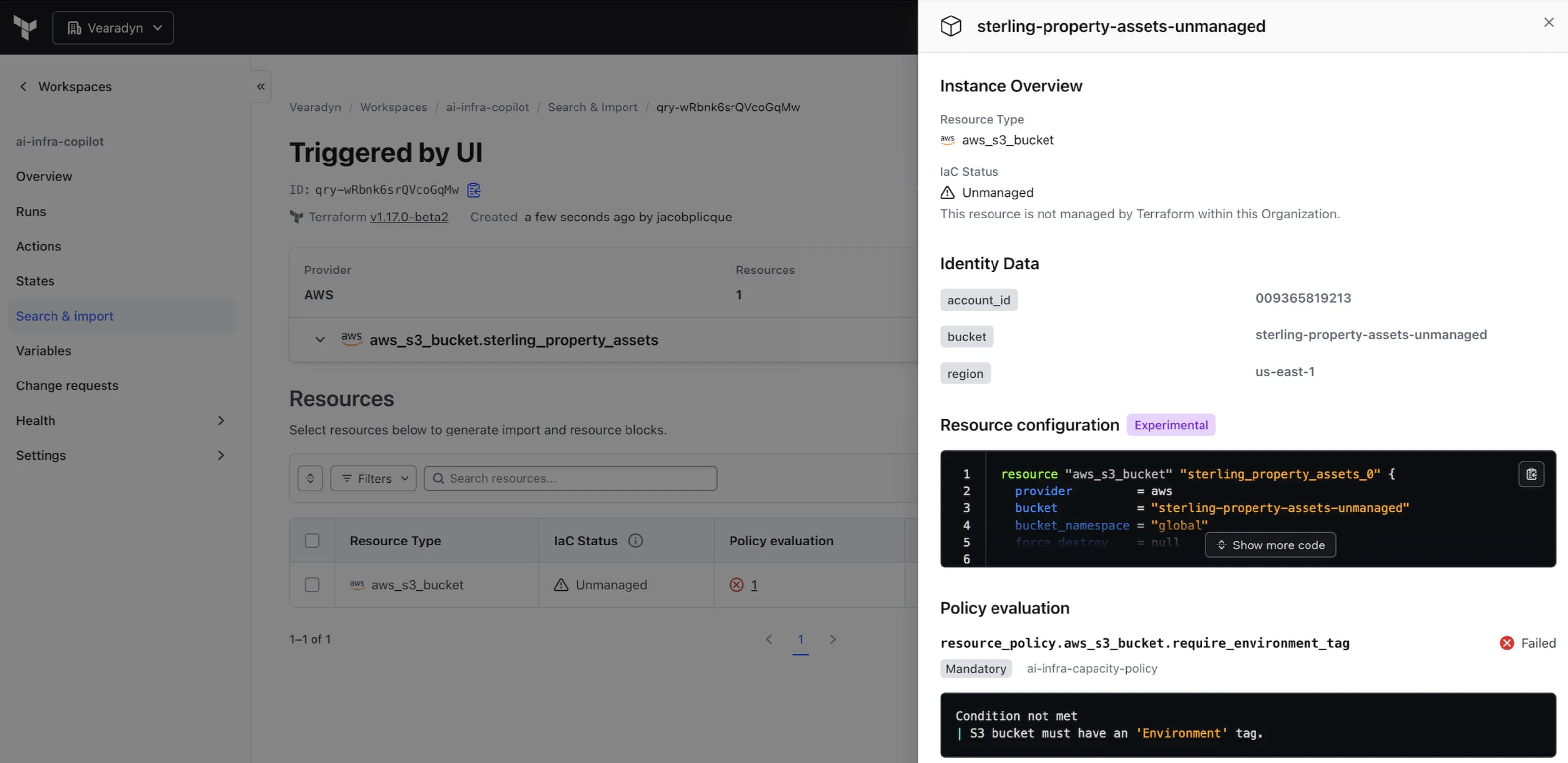
Users can easily understand resource status in the UI, including policy evaluation results, before importing
»Consume: Connect developers and agents to approved workflows
Autonomous infrastructure requires infrastructure to be consumed through trusted and governed workflows. Terraform enables platform teams to define approved infrastructure patterns once, allowing developers and AI agents to self-service infrastructure through the same policies, guardrails, and operational standards that ensure consistency, governance, and control at scale.
»Enable governed self-service with Terraform Developer Portal
Developers often wait on infrastructure requests or rely on custom portals, tickets, and disconnected workflows, while platform teams spend time fulfilling repetitive requests and maintaining additional tooling. As AI agents increasingly participate in development and infrastructure workflows, organizations also need a consistent way to ensure both developers and agents consume infrastructure through approved policies, guardrails, and patterns.
Terraform Developer Portal in public preview extends HCP Terraform natively from infrastructure automation into governed self-service for developers and agents. Platform teams can define approved infrastructure patterns once, while developers, automation, and AI agents consume them through the interfaces where they already work. Organizations can serve more users and workflows without introducing a separate self-service layer, while continuing to use the governance, identity, policy, execution, and automation capabilities they already rely on in HCP Terraform. This accelerates infrastructure delivery, reduces manual handoffs, and provides a consistent governance and execution model across developer and agent-driven consumption.
»Bring Terraform workflows to AI agents with Terraform MCP server
As AI agents become active participants in software delivery workflows, organizations need a trusted way for humans and AI agents to work from the same infrastructure foundation. Developer-friendly assistants such as IBM Bob, Claude Code, GitHub Copilot, Cursor, and other AI tools can help developers build applications, provision infrastructure, and deploy services using approved infrastructure patterns, governance controls, and Terraform workflows.
Terraform MCP server extends Terraform into the tools developers already use, allowing agents to interact directly with Terraform workflows. Agents can discover approved modules, generate infrastructure code aligned to organizational standards, analyze Terraform plans in natural language, access workspace information, and help teams make informed infrastructure decisions without constant context switching between tools. Importantly, these actions occur using the same authentication, permissions, and governance controls already established within Terraform.
Terraform MCP server was made generally available earlier this year and now we are adding Remote Terraform MCP server in public preview for HCP Terraform where no local installation is required, and developers don’t need to run or maintain the MCP server locally.
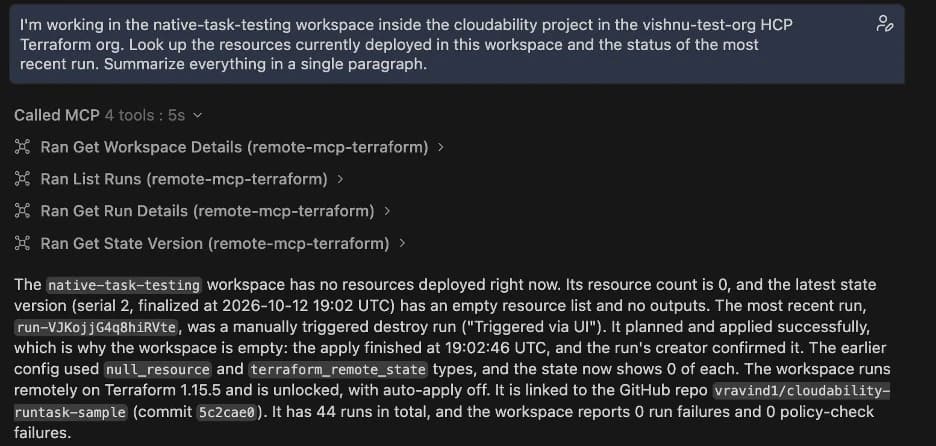
Bob retrieves live workspace state and run history directly from HCP Terraform — no copy-paste, no context switching, no manual lookups
»Scale: Operate with connected infrastructure intelligence
With trusted context and governed workflows in place, organizations can scale infrastructure operations across humans and AI agents. Connected intelligence and AI-assisted workflows help expand operational capacity while maintaining governance, trust, and control.
»Scale mission-critical operations with intent-driven workflows
Infrastructure operations are transitioning from manual administration toward AI-assisted and workflow-driven operations. At the same time organizations struggle to modernize mission-critical infrastructure because expertise is concentrated in shrinking pools of specialists and infrastructure changes carry significant risk, making operational processes difficult to modernize and scale.
Intent-driven workflows for Terraform on Z and LinuxONE combine Z-native discovery, rehearsal and simulation— provided through a conversational interface, all with enterprise guardrails and trusted governance required for mission critical workloads. This approach helps encode operational knowledge, simplify onboarding, accelerate Infrastructure-as-Code adoption, and improve operational consistency. Unlike general-purpose infrastructure automation, the solution is built for Terraform on Z: combining discovery, simulation, and rehearsal with Terraform workflows, bringing modern infrastructure automation to mission-critical Z and LinuxONE environments.
»Power autonomous operations with connected infrastructure intelligence
HCP Terraform powered by Infragraph provides the connected intelligence needed to safely operate autonomous infrastructure at scale. Terraform generates domain-specific information about infrastructure resources, relationships, governance, and lifecycle context. Infragraph transforms that information into trusted, near-real-time infrastructure intelligence.
By understanding what exists, how resources connect, what has changed, what is governed or unmanaged, and where actions may carry risk, humans and AI agents gain the context needed to make informed decisions and operate infrastructure with confidence at scale.
»From infrastructure automation to autonomous infrastructure
Infrastructure automation was built to make human-driven infrastructure operations faster and more consistent. As AI agents take on more infrastructure work, organizations need to evolve beyond task-level automation. Humans and agents need a common foundation for understanding infrastructure, taking governed action, and continuously operating as environments change.
Terraform brings trusted infrastructure context, governed workflows, and connected intelligence together across the infrastructure lifecycle. By connecting how infrastructure is defined, consumed, and operated at scale, Terraform provides the foundation for governed, autonomous infrastructure operations.
The next evolution of infrastructure isn't simply more automation. It's enabling humans and AI agents to operate infrastructure together on a trusted, governed foundation.
Experience how HCP Terraform can help you build a trusted foundation for modern infrastructure operations. Try HCP Terraform or contact our sales team to learn more.