


As organizations scale their cloud footprint, the challenge shifts from simply provisioning resources to managing the entire infrastructure lifecycle. Platform teams are often tasked with bringing brownfield infrastructure into modern, standardized infrastructure pipelines with the same visibility available in greenfield infrastructure.
Terraform Enterprise 1.2, generally available today, directly addresses these challenges with new capabilities designed to help teams quickly bring brownfield resources into Terraform and see more operational data in the Explorer tab.
Key enhancements in Terraform Enterprise 1.2 include:
UI-driven Terraform search queries: A visual interface to find and import unmanaged "brownfield" resources without writing code.
Explorer now GA in Terraform Enterprise: A centralized dashboard acting as a system of record for workspace health, version compliance, and drift.
Enhanced reliability diagnostics: New readiness and diagnostic API endpoints for faster, more accurate load balancer health checks.
New Day 2 operations: Capabilities to trigger Terraform Actions and replace resources directly from the UI.
Let’s dig into the details.
»UI-driven Terraform search queries
Background: One of the biggest hurdles in standardizing infrastructure is bringing pre-existing, unmanaged cloud resources under Terraform management. Traditionally, this required complex discovery scripts and manual mapping of resource IDs, a process that demanded deep HCL expertise. With Terraform 1.14 we introduced Terraform search and import to drastically streamline the process for finding and bulk-importing these external resources.
What’s new: Terraform search in Terraform Enterprise 1.2 introduces a visual "browse-and-select" interface. Users can discover untracked cloud resources using simple metadata queries (e.g. finding all EC2 instances tagged Owner:Finance). Once identified, these resources can be imported directly into a workspace without writing a single line of discovery code.
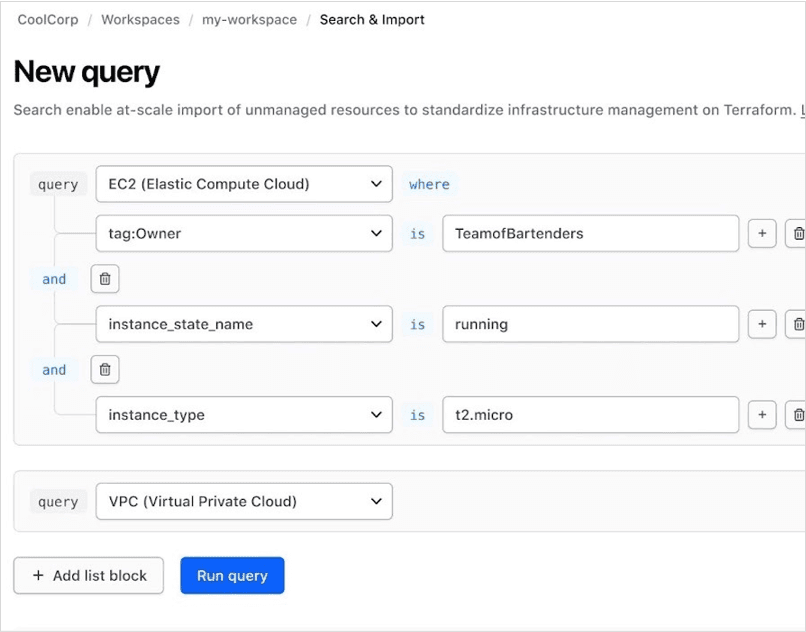
The new Terraform search and import UI-based query tool
Benefits:
Lower barrier to entry: Application teams can import resources without needing deep Terraform knowledge.
Accelerated governance: Rapidly move from unmanaged cloud sprawl to a governed state.
»Explorer now GA in Terraform Enterprise
Background: Terraform Explorer has been available in HCP Terraform, but after a beta period, Explorer is now also officially GA in Terraform Enterprise.
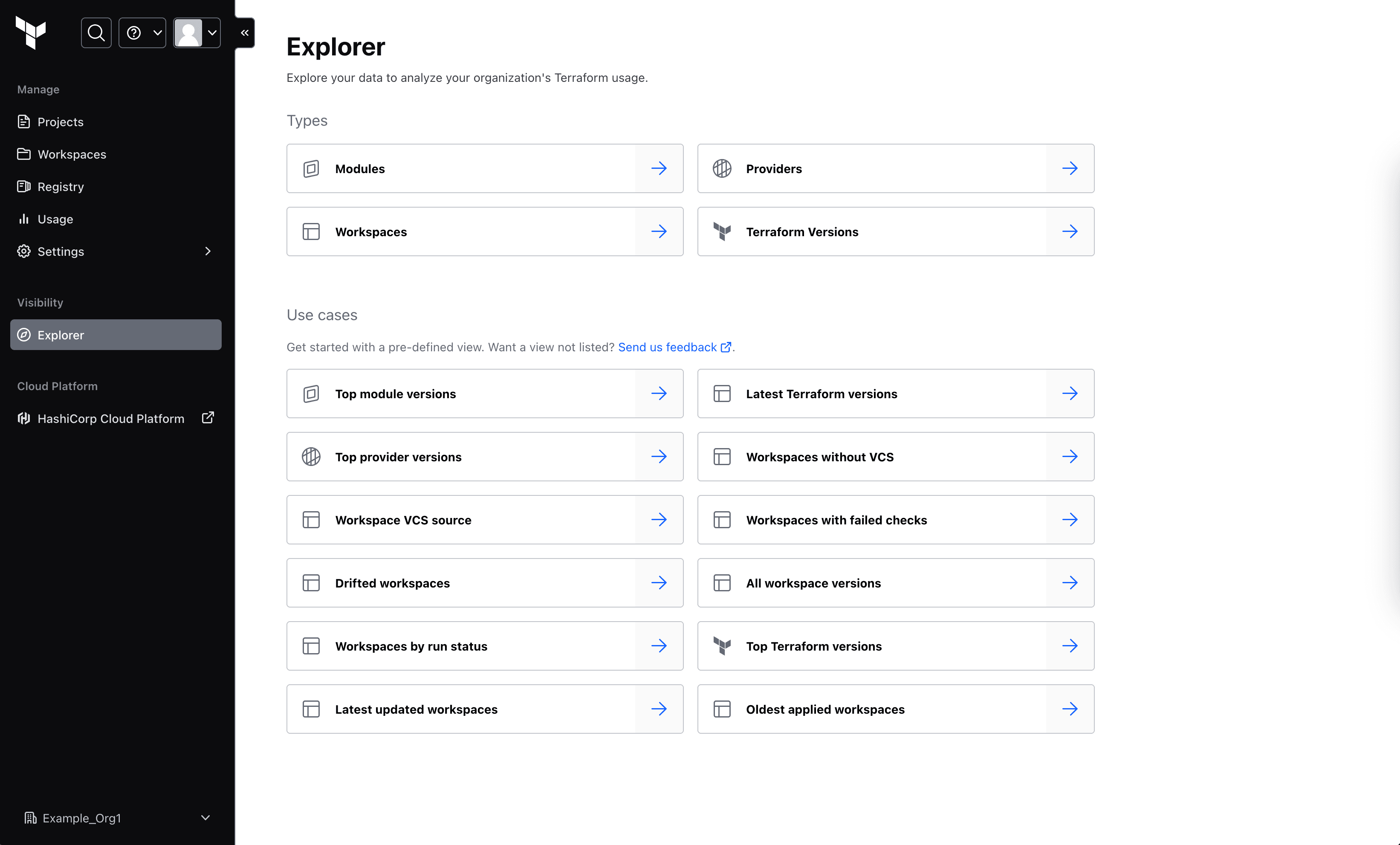
What’s new: Terraform Explorer is now GA in Terraform Enterprise. The Explorer tab (shown below) provides a consolidated view of all workspace data across the organization, effectively acting as an infrastructure system of record. Architecturally, Explorer leverages a secondary database to query this data, ensuring that intense reporting workloads never impact the performance of the core Atlas engine or running applies.
Benefits:
Improved security: Instantly identify workspaces using deprecated or revoked software versions.
Streamlined reporting: Use the new CSV exports and public Explorer API to extract operational data for external audits.
Optimized health: Quickly pinpoint workspaces without a connected VCS repo or those failing validation.
These are just a small sample of the benefits you can get from Explorer. See our full list of pre-build queries and instructions for building custom queries in the Explorer for workspace visibility documentation.
»Enhanced reliability and diagnostics
Background: Previous Terraform Enterprise health check API endpoints were too broad in some cases. When Terraform Enterprise exposed this broad information to load balancers, it was still difficult at times for them to distinguish between a single degraded node and a wider, transient backend issue. This limited their ability to isolate problems cleanly and route traffic effectively.
What’s new: Terraform 1.2 introduces two new API endpoints and CLI commands to give load balancers and admins more precise control:
Readiness checks (/api/v1/health/readiness): An unauthenticated endpoint designed for load balancers to instantly detect if a node is ready to accept traffic.
Diagnostic checks (/api/v1/diagnostics): An authenticated endpoint that provides detailed status information for troubleshooting.
Benefits: These checks allow for faster isolation of degraded nodes, reducing potential downtime from minutes to seconds.
Note: Legacy health check endpoints are now deprecated; we encourage updating monitoring scripts to adopt these new patterns.
»New Day 2 operations
There were several other enhancements in Terraform Enterprise 1.2 around Day 2 operations:
Terraform actions: Terraform actions are built directly into Terraform providers to allow engineers to build workflows that can third-party tools outside of Terraform. This capability, which was comprehensively supported first in HCP Terraform, is now also fully supported in Terraform Enterprise.
Resource replacement from the UI: Users can now initiate a "replace resource" run directly from the workspace UI. This simplifies the workflow for fixing degraded objects (like a crashed VM) without leaving the dashboard context.
»Upgrade notes
Terraform Enterprise 1.2 includes several additional key fixes and architectural updates:
S3 data integrity: Users now have the option to enable MD5 checksum validation (TFE_OBJECT_STORAGE_S3_ENABLE_MD5_VALIDATION) using third-party S3-compatible storage. Support for this fallback depends on the storage provider and may not function in all environments.
Software Product Compatibility Reports: Terraform Enterprise has been added to the broader IBM Software Product Compatibility Reports library (under the title “IBM Terraform Self-Managed), centralizing our prerequisites into a single, dynamic report to simplify upgrade planning.
Deprecation notice: Please note that PostgreSQL 13 support has been removed in this release.
»Get started
Terraform Enterprise 1.2 is available for download today. For more details on the upgrade process, please review the upgrade guide and the release notes.