

HashiCorp Vault’s Transit secrets engine provides encryption-as-a-service, allowing applications to encrypt and decrypt sensitive data without managing cryptographic keys directly. In this model, applications send data to Vault Transit for encryption and make a similar API call to decrypt the ciphertext.
Vault manages the underlying keys while enforcing authentication and authorization policies that determine which clients can encrypt and decrypt data. This approach works well for many application use cases, particularly when encrypting small objects such as tokens, secrets, or application data.
However, when working with large artifacts or streaming data, this model becomes less practical. Transferring large payloads to Vault for encryption or decryption can introduce performance bottlenecks and unnecessary network overhead.
To address these challenges, we are introducing an SDK that enables applications to use envelope encryption with Vault Transit. This approach allows Vault to continue managing cryptographic keys and access policies while enabling encryption and decryption to occur locally within the application.
»Envelope encryption with Vault
Envelope encryption is a common pattern used across the industry to encrypt large datasets and high-volume data streams without introducing complex key management workflows.
Rather than encrypting the entire dataset with a centralized service, envelope encryption separates data encryption from key management.
In this model:
A data encryption key (DEK) is generated for each artifact
The DEK is encrypted using a Transit key managed by Vault
The encrypted DEK is stored alongside the encrypted data
Vault remains responsible for key management and access control, while applications perform the actual encryption and decryption operations locally.
»How it works
The envelope encryption workflow involves two main operations: encryption and decryption.
»Encryption
When encrypting an artifact:
The application requests a new data key from Vault Transit.
Vault generates:
A DEK
An encrypted data key (EDK), encrypted using a Transit key
The application uses the DEK locally to encrypt the data
The encrypted artifact stores both the ciphertext and the EDK
The encrypted artifact can then be safely stored or transmitted through storage systems or data pipelines.
»Decryption
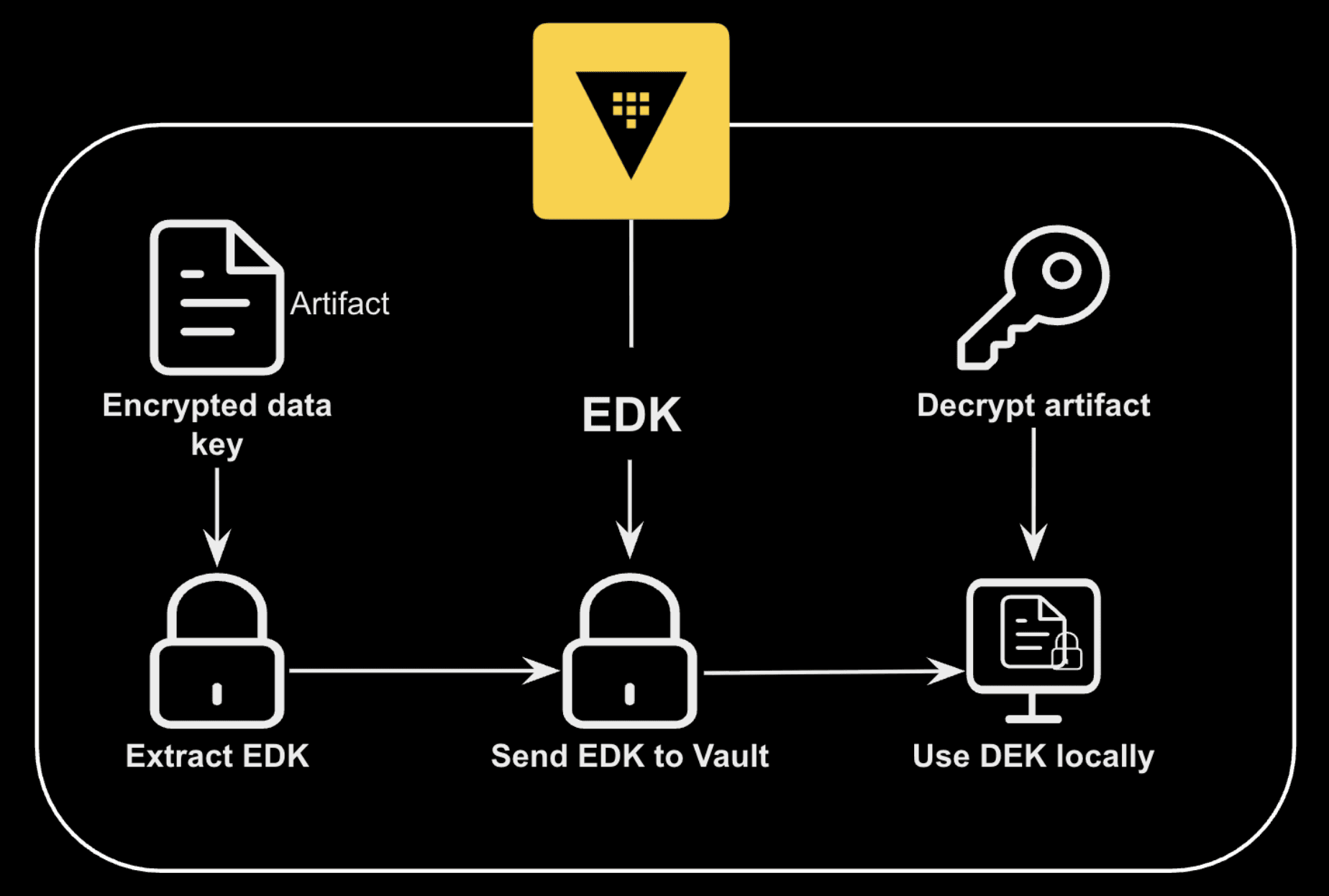
When a consumer needs to decrypt the artifact:
The client retrieves the encrypted artifact
The client extracts the EDK
The client sends the EDK to Vault Transit for decryption
Vault returns the decrypted DEK if the client is authenticated and authorized
The client uses the DEK locally to decrypt the artifact
Vault never needs to receive or process the encrypted artifact itself — only the encrypted key.
»Benefits
»Simplified key management
Envelope encryption reduces the complexity of managing keys across distributed systems. Instead of provisioning and maintaining keys for every application or workflow, operators manage a smaller set of Transit keys in Vault. For each artifact, a temporary DEK is generated and used locally to encrypt the data, while an encrypted version of that key is stored with the artifact.
This approach centralizes key governance in Vault while eliminating the need to distribute or manage large numbers of application-level keys. It also improves efficiency by allowing encryption to occur locally in the application, avoiding the need to transfer large payloads to Vault for processing.
»Flexible policy control
Transit keys can be associated with different Vault policies, allowing operators to define clear security boundaries across applications, environments, or data pipelines. Policies determine which identities are allowed to encrypt or decrypt data protected by a given Transit key.
Because encrypted data keys travel with the artifact, data can move through storage systems and pipelines without requiring key distribution between services. Vault enforces access control centrally, while applications handle encryption locally. This model simplifies secure workflow design while improving efficiency by keeping Vault focused on key management rather than large-scale data processing.
»Distributed encryption at the edge
With envelope encryption, the actual encryption and decryption of data occurs within the application or service handling the artifact rather than inside Vault itself. Vault continues to manage cryptographic keys and enforce access policies, while the client performs the encryption operation locally.
This distributes cryptographic computation across many clients rather than centralizing it within Vault clusters. As a result, Vault no longer needs to receive and process large payloads, which reduces network overhead and avoids potential bottlenecks when working with large files or high-throughput data streams.
Because encryption happens close to where the data is produced or consumed, applications can encrypt and decrypt data with lower latency and improved throughput. Vault is only involved for lightweight key operations, such as generating or decrypting the encrypted data key, significantly reducing round trips and improving overall performance.
This model also enables strong support for large artifacts and streaming workloads. Since applications encrypt data locally, they can process large files or continuous data streams in real time without transferring entire payloads to Vault. The prototype implementation successfully encrypted artifacts up to 256 TB, and the design can support artifacts up to 264 bytes (approximately 18 exabytes), making it suitable for even the largest data processing environments.
By combining edge-based encryption with centralized key management, organizations can maintain Vault as the root of trust while achieving the performance and scalability required for modern data pipelines.
»Crypto-shredding
Envelope encryption also enables crypto-shredding, a powerful mechanism for reducing long-term data exposure risk. Because encrypted artifacts depend on Vault to decrypt their associated EDKs, access to the underlying data is ultimately controlled by the Transit key that protects those keys.
If the Transit key is removed, disabled, or destroyed, Vault can no longer decrypt the EDK. Without access to the DEK, the encrypted artifact becomes permanently unreadable.
This approach significantly reduces operational risk in environments where data may exist in multiple locations, such as backups, archives, or distributed storage systems. Instead of needing to locate and delete every copy of sensitive data, operators can effectively render the data inaccessible by managing the lifecycle of the corresponding Transit key.
Crypto-shredding therefore provides a practical mechanism for secure data retirement, helping organizations reduce exposure to sensitive data while simplifying compliance with data retention and destruction requirements.
A practical example of this pattern can be seen in how organizations are applying Vault Transit with envelope encryption to support AI and high-throughput data workloads. In a recent implementation with Ariso AI, Vault was used as the root of trust for encryption while enabling large-scale artifact processing and streaming pipelines without routing data through Vault itself. This approach allowed encryption to scale alongside AI workloads while maintaining centralized key management and policy enforcement. As data volumes continue to grow, particularly in AI and machine learning pipelines, this model demonstrates how organizations can achieve both performance and strong security guarantees without introducing bottlenecks.
For agentic AI systems, this approach ensures that autonomous workflows can securely generate, process, and access encrypted data at scale, while keeping cryptographic control centralized and policy-driven, reducing the risk of data exposure as agents operate across distributed environments.
»Getting started
Modern applications increasingly operate on massive datasets, distributed systems, streaming pipelines, and AI-driven workflows where traditional centralized encryption models can become operational bottlenecks. Envelope encryption with Vault Transit provides a scalable alternative that preserves centralized cryptographic governance while allowing encryption and decryption to occur where data is actually produced and consumed.
By separating key management from data processing, organizations can:
Protect large artifacts and high-throughput streams without routing payloads through Vault
Maintain centralized policy enforcement and auditability
Reduce operational complexity around key distribution
Enable crypto-shredding and stronger lifecycle controls for sensitive data
Support modern AI and agentic workflows that require secure, distributed access to data at scale
With the new SDK, Vault continues to serve as the root of trust while applications perform encryption locally using short-lived data encryption keys protected by Transit. This model combines the security and governance benefits of centralized key management with the performance characteristics required for modern distributed architectures.
As data volumes continue to grow, particularly across AI, machine learning, and autonomous systems, envelope encryption provides a practical foundation for securing large-scale workloads without compromising performance, scalability, or operational control.
To learn more, explore the Vault Transit secrets engine documentation and the envelope encryption SDK examples to start integrating scalable encryption workflows into your applications today.