



AI agents are reshaping what enterprises need to secure. They join workloads, applications, machines, and human users in accessing increasingly distributed infrastructure, creating new requirements for identity, authorization, credentials, access, and governance.
At TechXchange, IBM is introducing new capabilities across Verify, Vault, and Boundary to help enterprises establish trusted identities, enforce appropriate access, strengthen cryptographic security, and govern activity across hybrid environments, creating a stronger foundation for agentic AI and autonomous operations.
»Agent Identity enables trusted AI agents across the enterprise
AI agents are rapidly becoming active participants in enterprise operations. As agents gain the ability to access systems, invoke tools, orchestrate workflows, and act on behalf of users, organizations need a consistent way to establish agent identity, manage delegated authority, enforce access controls, and maintain accountability throughout the agent lifecycle. Traditional identity systems were not designed to address these new requirements.
IBM Agent Identity, now generally available, helps organizations secure AI agents as first-class identities through a coordinated identity control plane. It enables enterprises to register agents, establish ownership, preserve delegated authority and context as agents act across systems, enforce task-scoped authorization, protect credentials through integration with HashiCorp Vault, and maintain end-to-end auditability. Together, these capabilities help organizations understand which agents are operating, what they are authorized to do, and how their actions trace back to human or business approvals, establishing the trust and accountability needed to scale agentic AI in production.
Together with IBM Verify, HashiCorp Vault, and watsonx Orchestrate, IBM Agent Identity provides a foundation for securing the agent lifecycle, helping enterprises accelerate AI adoption while strengthening governance, reducing identity-related risk, and building trust in autonomous operations.
»Vault strengthens identity-based security for the autonomous hybrid cloud
Organizations adopting AI, cloud-native applications, and automation face a changing security reality: rapidly growing populations of non-human identities, increasing cryptographic risk, and operational complexity across distributed environments. With the general availability of Vault 2.2, IBM helps customers address these challenges through three key outcomes. Govern AI identities with confidence by extending identity governance to AI agents and non-human identities, strengthening least-privilege access, and establishing trusted workload authentication. Eliminating the long-standing Secret Zero challenge for on-prem workloads is another way that Vault 2.2 helps organizations govern identities with confidence. With vTPM support for Linux VMs, workloads can authenticate to Vault using cryptographic proof tied to an enrolled virtual TPM rather than relying on distributed bootstrap secrets, strengthening machine identity. Automate certificate lifecycles and improve crypto agility by modernizing PKI, automating public certificate management, and advancing post-quantum readiness. These capabilities help organizations reduce identity and cryptographic risk while improving resilience as AI-driven operations scale.
Vault 2.2 also helps customers drive enterprise scale and adoption by deepening IBM ecosystem integration, including Vault on IBM Power, while improving usability, automation, and operational visibility. Together, these investments help organizations reduce fragmentation and standardize identity, secrets, certificate, and key management across IBM and hybrid environments. Vault 2.2 strengthens Vault's evolution beyond secrets management as an identity-based security solution, helping customers securely adopt AI, reduce operational and cryptographic risk, and build the trusted security foundation required for the autonomous hybrid cloud.
»Announcing the public preview of Vault Arc and Secure Hub
As infrastructure, machine identities, and AI agents expand across hybrid and multi-cloud environments, enterprises need security platforms that can evolve with new requirements while building on the investments they rely on today. Vault Arc and Secure Hub, now in public preview, expand HashiCorp’s Security Lifecycle Management capabilities to help organizations modernize on their terms, strengthen governance across their security environments, and prepare for the emerging security requirements of agentic AI.
»Secure Hub: Govern Vault at scale
As Vault adoption expands across teams, regions, and environments, fragmented visibility and reporting make it increasingly difficult to monitor security resources, assess operational health, and maintain consistent governance.
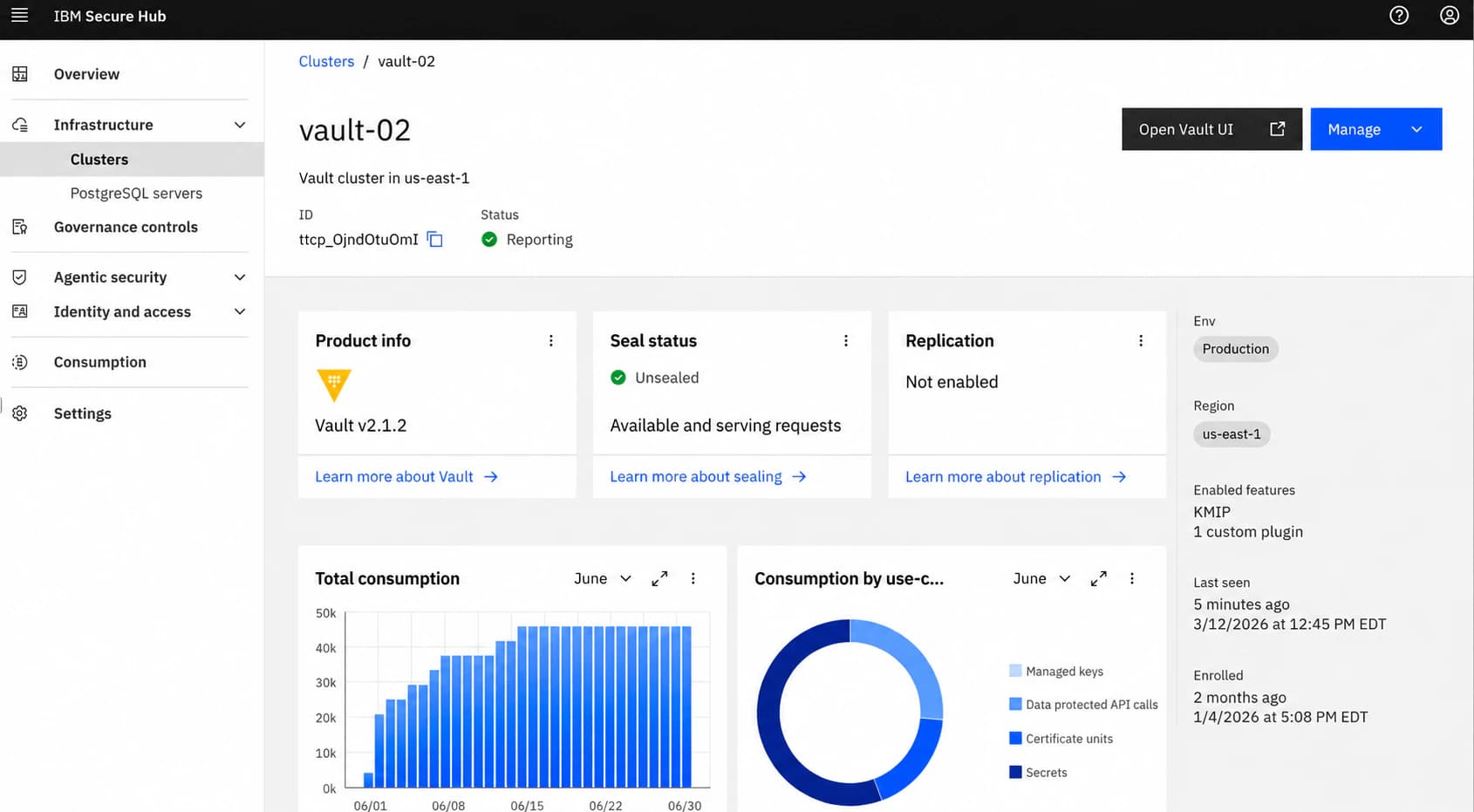
Secure Hub addresses these challenges by providing centralized visibility, reporting, and governance across distributed Vault environments. The public preview introduces cross-environment insights into operational health, secrets, and certificates, along with a common governance experience spanning Vault Enterprise and Vault Arc.
»Vault Arc: Expanding Vault for evolving enterprise needs
Vault Arc expands the Vault portfolio with a new architecture designed for evolving scale, operational, and security requirements. It complements the Vault environments organizations rely on today, giving customers greater flexibility in how they deploy Vault across different workloads and use cases.
The Vault Arc public preview introduces capabilities designed to simplify operations and developer workflows, strengthen authorization and governance, and support emerging machine and agentic workloads. Its architecture provides a foundation for a new resource and IAM model, scoped and ephemeral authorization, agent and non-human identity governance, and greater cryptographic agility.
Join the public preview of HashiCorp Vault Arc and Secure Hub to explore the new capabilities, share your feedback, and see how they can extend your organization's security lifecycle management strategy.
»Boundary improves target auto-discovery and introduces an MCP server
HashiCorp Boundary 1.1 is now available, improving administration for enterprise scale and enhancing external integration. Boundary also introduces an MCP server, currently in public preview, which is used to help reduce administrative tasks and facilitate agentic access.
»Improved integrations with App Tokens
App tokens is a new enhancement that improves the way external applications securely interact with Boundary for CI/CD workflows, infrastructure automation, observability, or any type of integration. Prior to App token, the process for external applications to authentication with Boundary involved multiple steps that were not efficient and was potentially brittle. With App tokens, the administrators can create authorization tokens more easily with customized time-to-live and scope for each external application, improving security and efficiency.
»Higher scale with cross-account target auto-discovery
Boundary can auto-discover and onboard virtual machines in Amazon Web Services (AWS), Microsoft Azure, and Google Cloud, greatly reducing administrative effort. Boundary’s latest release improves this process even further by making auto-discovery easier across multiple AWS accounts. Prior to the enhancement, customers needed to configure Boundary plugins in each AWS account that needed auto-discovery. Now, customers can configure the Boundary plugin in a single account and Boundary can discover and onboard virtual machines across multiple AWS accounts with minimal additional configuration effort. This enhancement further reduces administrative effort for customers with a large number of AWS accounts.
»Reduce management and facilitate secure agentic AI connections with MCP Server
Boundary is introducing a Model Context Protocol (MCP) server that simplifies management and troubleshooting for administrators. The MCP server also facilitates AI agent access to infrastructure resources without requiring agents to have custom code or additional Boundary client tools.
For administrators, the Boundary MCP server relieves a lot of burden by allowing them to interact with Boundary clusters using natural language with common AI assistant clients like Claude, Cursor, and Codex. Administrators can ask questions, perform administrative tasks, and troubleshoot issues without needing to know the exact UI workflow, CLI command, or API call. As a result, administrators spend less time learning Boundary tools and searching through documentation.
For AI agents that are MCP-compatible, the Boundary MCP server can facilitate session and connections through Boundary to securely access infrastructure resources like SSH and RDP target systems. Agents do not need to have custom Boundary code or Boundary client tools to connect, making it much more scalable to enforce secure guardrails for agentic access within a network.
See the latest Boundary 1.1 blog for more details on the latest Boundary releases.
Securing agentic AI requires more than protecting individual credentials or connections. Organizations need coordinated controls that establish trusted identities, define what human, machine, and AI identities are authorized to do, secure how they access resources, and maintain governance across distributed environments.
The latest capabilities across IBM Agent Identity, Vault, Secure Hub, Vault Arc, and Boundary extend security across this lifecycle. Together, they help organizations strengthen identity and cryptographic security, govern Vault environments at scale, and secure infrastructure access as AI agents take on more autonomous roles across the hybrid cloud.
To explore how organizations can apply continuous trust across the agentic lifecycle, read the IDC white paper, Secure enterprise agentic AI with continuous trust. For a closer look at the underlying architecture and controls, watch the Securing the agentic runtime technical deep-dive webinar.